Campus buildings: Do we renovate that university building or build a new one?
December 02, 2025
December 02, 2025
How to take adaptive reuse and modernization of campus buildings to the next level
A version of this blog first appeared as “Campus updates: Renovate that university building or build new?” in Design Quarterly, Issue 25.
Look at any university brochure sent to prospective students. Often, it showcases historic campus buildings.
There may be no better example of the connection between people, emotion, and the built environment than a university building. For many alumni, these campus buildings are a portal to the past—their best years. For prospective students, the campus is a future full of possibilities and community. The university’s prestige and tradition are wrapped up in the campus buildings themselves. At universities, the urge for preservation is strong.
And yet they need to modernize. Universities need to stay competitive to survive. They need to consider adaptive reuse of campus buildings to stay relevant.
Universities face a demographic drop-off. By 2041, the number of traditional-age incoming college students will be down 13 percent. Colleges need to show that they’re worth the tuition. They need spaces that fit today’s students and the way they learn. Meanwhile, their older buildings have limitations.
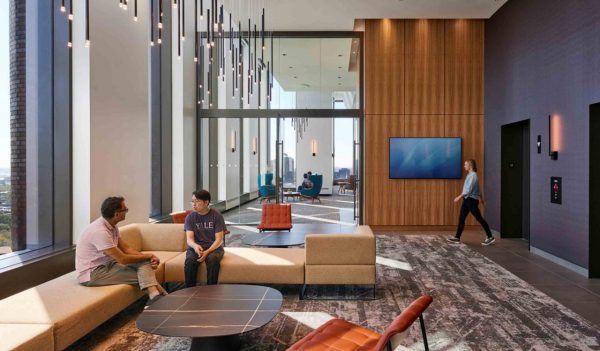
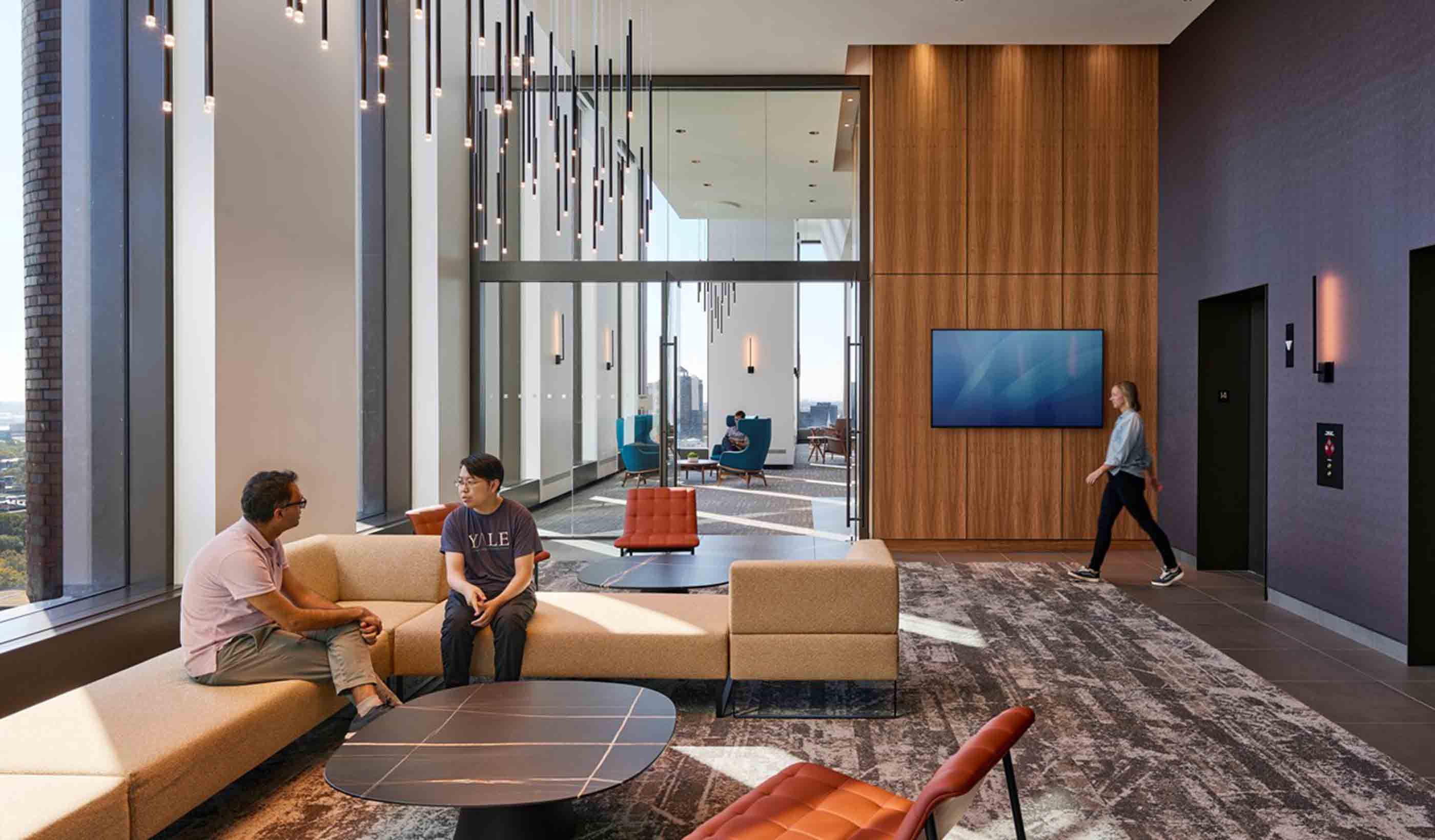
Yale University’s Kline Tower in New Haven, Connecticut, renovated a mid-century tower after the science programs were moved to a different facility.
As an interior designer, I think working on campus renovation projects is both exciting and challenging. I’ve had the chance to work on these kinds of projects for big, well-known universities and smaller schools, too. The Northeast has a lot of colleges and universities with old, interesting buildings. But all across North America, there are schools with buildings that are worth updating.
1. Student experience
Collaboration and community building: Universities want their students and professors to interact. And they want the campus to support their students’ mental health. They want to enhance the campus buildings with social and collaborative spaces.
Older buildings often have smaller interior spaces. When we renovate them, we can create multipurpose areas. With the emergence of hybrid learning, these interactive spaces have become important as places where students come together. Libraries are emerging as new centers for engagement.
Universities want flexible spaces that can be used for many activities. These areas are designed for studying, working together, and giving students and instructors a place to meet and interact.
Mental health and wellness: Experts are concerned about a mental health crisis on campus. In a 2024 survey, 70 percent of students said they have struggled with mental health since starting college.
Universities want to help students feel connected and involved by giving them friendly spaces where they can hang out with friends or do schoolwork. These flexible areas, along with special rooms for relaxing and easy-to-reach dining halls, are all important for supporting students’ mental health.
For many universities, the campus is sacrosanct. The school’s traditions, stories, and history are woven into its buildings.
Many mid-century university campus buildings were not built with health in mind. Older buildings may suffer from lack of natural light and poor ventilation. They may have harmful materials.
Universal design, accessibility, and inclusivity: Schools want to make sure everyone can use their campus buildings. Many older buildings lack accessible features like ramps or elevators. Some buildings are also hard to get to from other parts of campus. When schools renovate, they often add elements such as elevators, wider exit stairs, clearer signs, and other changes to help everyone get around and feel welcome.
Genio.co says that about 16.5 percent of college students are neurodivergent. Universities are changing their buildings to follow Universal Design for Learning (UDL). It helps these students. Schools want to create spaces where all students feel like they belong and can learn comfortably.
2. Long-term flexibility and maintenance
Universities need buildings that can grow and adapt with them as they adjust their programming. Most older campus buildings were built for one purpose. Now, they need to serve many purposes. When they renovate a university building now, they don’t want to be stuck in 2025 when the calendar turns to 2040.
Many campus buildings are more than 50 years old. Higher education construction boomed in the post-war period and in the early 2000s. APPA (formerly the Association of Physical Plant Administrators) says that at many institutions, about 75 percent of facilities are 30 to 40 years old. These buildings have already missed their first renewal. Older campus buildings that haven’t been renovated can be costly to maintain. An APPA report says work orders in buildings 25 to 50 years old average $2.35 per square foot versus $1.40 for buildings under 10 years of age.
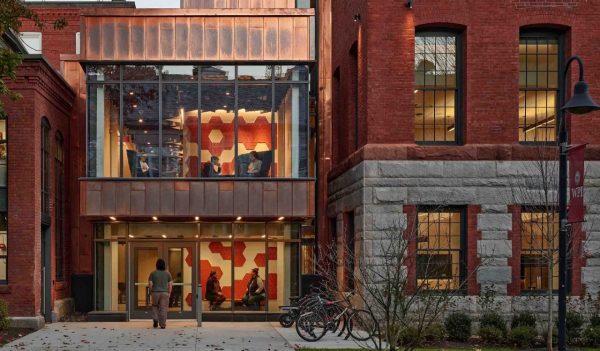
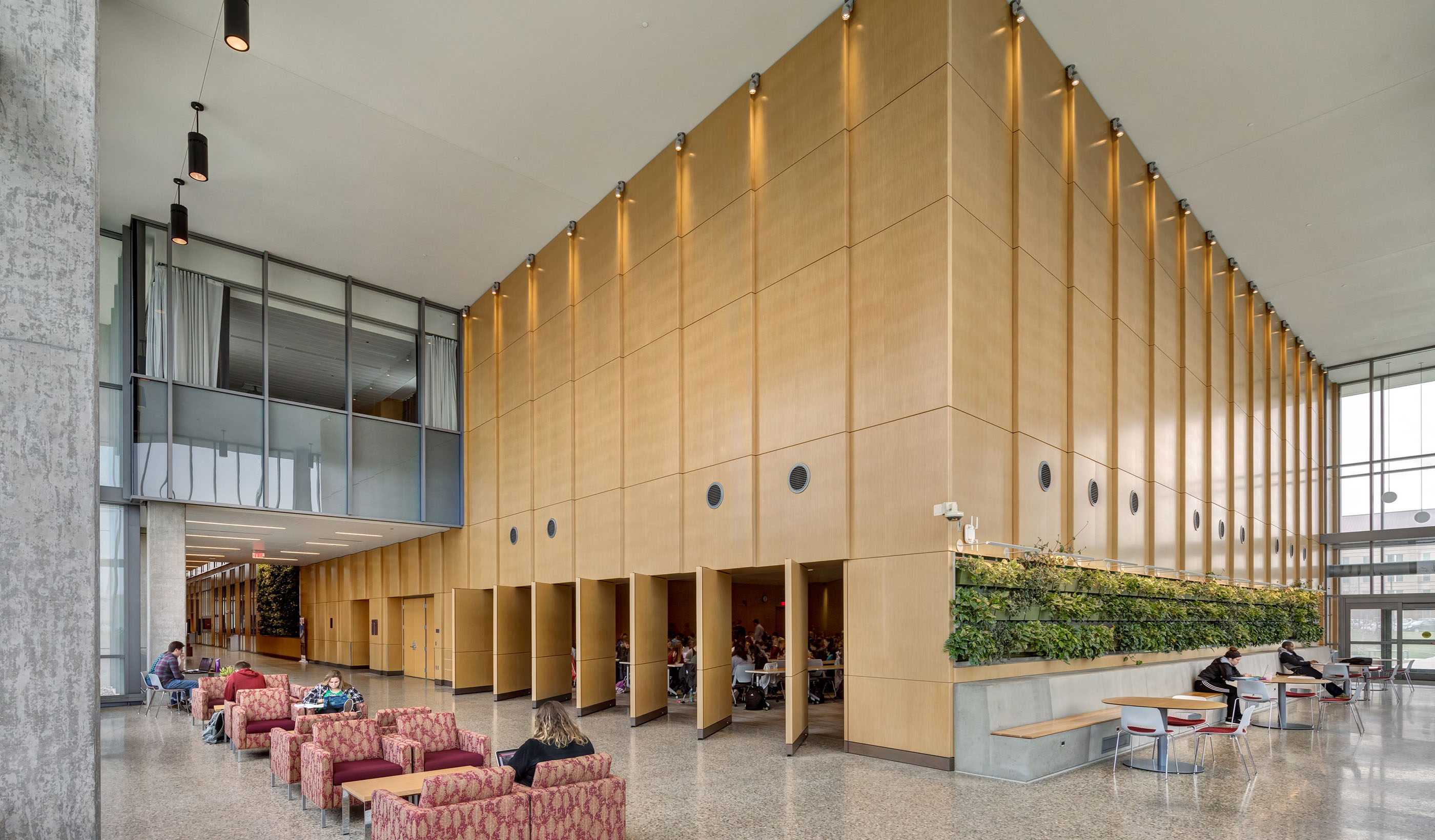
Stratton Hall at Worcester Polytechnic Institute in Worcester, Massachusetts, was built in 1894. It once housed the school’s engineering school. A renovation added a four-story vestibule, improved student flow, and study nooks.
Historic character and legacy: For many universities, the campus is sacrosanct. The school’s traditions, stories, and history are woven into its buildings. This can apply to a nineteenth-century library or a mid-century lab. So, schools want to maintain their built legacy. Alumni, faculty, students, and potential students want to see special places preserved on campus.
Limited space: Universities may need new spaces to suit their programs. Land acquisition may be impossible or expensive. Expansion may not be an option on many campuses. Schools need to figure out how to adapt the spaces they own to what they are offering.
Cost-effectiveness: Colleges are investing in building reuse to achieve more efficient use of the space they already have. Traditional classrooms and lecture halls are often occupied less than 60 percent of the day. So, universities may want to rebalance their space. If they can transform existing buildings into modern spaces for learning, they will save money versus demolition or letting underutilized spaces languish. Schools want to be known as wise spenders to their alumni and students. And they may be eligible to receive grants for preserving their historic buildings.
Sustainability: All over the world, more than 1,000 colleges and universities have pledged to go carbon neutral by 2050. These Race to Zero schools keep track of and share how much carbon they produce. Many are choosing clean energy sources. They are making their building operations more efficient. By reusing old buildings instead of tearing them down, universities can cut demolition waste and reduce their embodied carbon bill.
Let’s look at three examples of what’s possible in campus building reuse.
Case study 1: Update vertical labs for functionality and connectivity in a modernist tower.
Originally a mid-century tower designed by Phillip Johnson, Yale’s Kline Tower labs were out of date. Its science programs were now in the Yale Science Building. The tower had a dark interior, offering no opportunity for connection or collaboration. The challenge was to modernize the building and make it more useful while maintaining its historical presence.
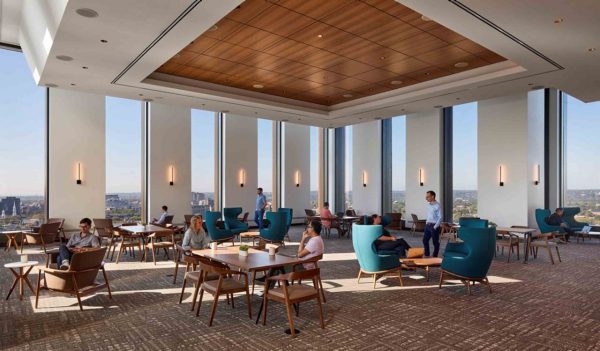
One of the highlights of the renovation of Yale University’s Kline Tower is the rooftop faculty lounge.
To address these issues, we redesigned the building with these goals:
The renovation stripped down the existing structure and took out lab components to create classrooms and department floors, supporting what’s known on campus as Science Hill. We added monumental “triplet” stairs to connect multiple floors, for accessibility and social interaction. We designed large, flexible gathering spaces, such as the Commons, which Yale uses for seminars, guest speakers, department meetings, and study areas. We opened window lines to allow natural light into the core of the building.
We transformed the 14th floor mechanical space into a faculty lounge with 360° views. The renovation made it easier to access and navigate the building. We also built new connections on the main floor and underground, so people can easily walk to nearby buildings.
The renovated Kline Tower has popular open-concept spaces, which boost collaboration. This historic reuse project is targeting LEED Gold certification.
Bonus: The rooftop lounge with a 360° view has emerged as a prestigious third place for faculty. The hospitality-inspired floor can host large seminars and special events. It’s been a boon for faculty collaboration.
Case study 2: Improve navigation and add collaboration space to a nineteenth century academic building.
Stratton Hall at Worcester Polytechnic Institute (WPI) was built in 1894. It once housed the WPI engineering school and has been used by different departments over the years. Like many old buildings, it wasn’t easy for everyone to get around, it didn’t have good places to study or hang out, and it was confusing to navigate.
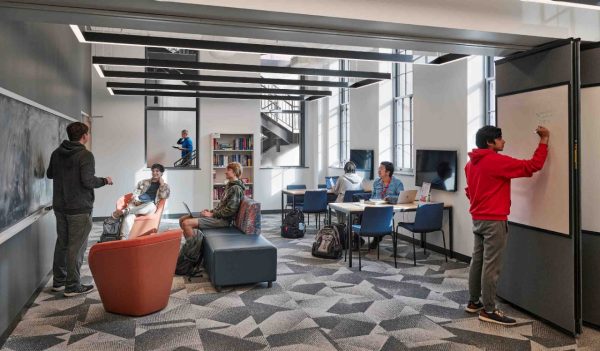
The renovation of Stratton Hall at Worcester Polytechnic Institute provides math and science students with new spaces for studying and working in groups.
To fix these problems, Stratton Hall got a gut renovation. A new four-story vestibule in copper and with an elevator was added, making it safe and accessible for everyone. This new entrance also links Stratton Hall to the Project Center next door. The main hallways were widened so students can find their way more easily, and cozy study nooks were built between the building’s columns in the corridors. The design also brought back the original look of the building’s brick exterior. New student lounges and a tutoring center encourage students to collaborate and get help when they need it.
Now, the 32,000-square-foot building is fully accessible, easier to navigate, and feels much more welcoming. Math and science students have new spaces for studying, working in groups, and tutoring each other.
Bonus: Stratton Hall has new energy-efficient windows, better heating and cooling systems, and improved insulation. Quite simply, it is a more comfortable and durable place to learn.
Case study 3: Convert an old industrial space to a contemporary research hub.
When Tufts University wanted to create a place for interdisciplinary research on its new Science and Technology Corridor, it discovered a centuries old, timber-frame warehouse in dire need of repair. The goal was to fix up this warehouse and transform it into a space where many departments could collaborate and share ideas.
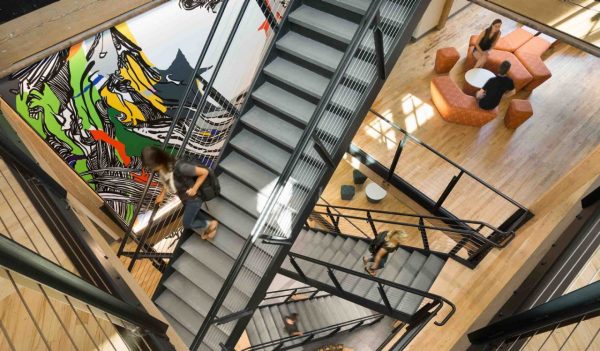
The Collaborative Learning and Innovation Center at Tufts University in Medford, Massachusetts, which serves as an important historic gateway to the university.
The renovation retained the historic character of the building’s timber structure. It was inspired by the school’s mascot, Jumbo the Elephant. And the design puts the focus on interdisciplinary collaboration. A whimsical connecting stairway, surrounded by breakout zones for learning and socializing, acts like a modern-day watering hole. It brings students together from all disciplines to satisfy their thirst for knowledge. All of this supports new academic spaces in the university building: shared classrooms, open and closed offices, dry labs, and swing space.
Today, the Collaborative Learning and Innovation Complex (CLIC) at Tufts is a 4-story building with 95,000 square feet of space. It’s an important historic gateway to the university and acts as a hub for science and social science groups to come together to work and share ideas.
Bonus: We boosted building envelope efficiency with triple-paned windows and six inches of spray insulation in the exterior walls. A rain garden collects stormwater from the canopy roof. These are some of the elements that helped the building achieve LEED Silver.
1. Balance cost and functionality. Go ahead and run the numbers before you build new. Calculate the cost-effectiveness of renovation versus demolition of campus buildings. See what will deliver the best return on investment. And think about tomorrow’s needs, not just today.
2. Prepare for the future. The world of higher education is dynamic. The way universities teach is just as likely to change as the world and jobs for which they prepare students. So, it’s best to build flexibility into any renovation project. Thoughtful renovations should help prepare buildings for any future changes for needs and functions. Be ready to match new educational practices and technologies.
3. Get creative. Find creative new uses for spaces that enhance campus life beyond the usual programmatic needs. Bringing back the faculty lounge at Kline Tower, for example, resulted in a new space serving multiple needs.
4. Promote the benefits of renovation. Explain the benefits of renovation to the student body and alumni. Universities need to highlight the building improvements to justify their spending. On-site banners at construction sites may be just as effective as digital messaging here.
5. Balance legacy with mission. Show that you understand how important it is to preserve the historical character and legacy of buildings. Remember that retrofitted campus buildings need to serve each school’s unique mission.